
May Day
or, Good Luck with the Weather


The problem is, us Ireland and United Kingdom dwellers, we love a sunny day. So used are we to grey, damp, drizzly summers that when the sun comes out, we welcome it like sun worshippers.
“I must admit, I love it,” an older friend says.
“Gorgeous, gorgeous, gorgeous,” my sister says, and I have a sneaking suspicion she says this because she wants to dissuade me from saying what I’m thinking, me sitting out in the hot sun at 10am on the May Bank Holiday Monday, sun hat and sunnies, a cup of my brother’s coffee, and yes, it is gorgeous. In a way.
But it is May. Thirty three degrees Celsius. Seventeen degrees above average for this time of year. Seventeen degrees. So hot that I have relented and climbed up into the loft to pull out my fan. A fan that usually doesn’t show its silver spinning face ’til August.
“We are not prepared for this,” a lady says to me at the community choir I go to sometimes on a Tuesday night. We are sitting there, in a circle, a tiny fan over in the corner doing its highest level best, and we are wilting.
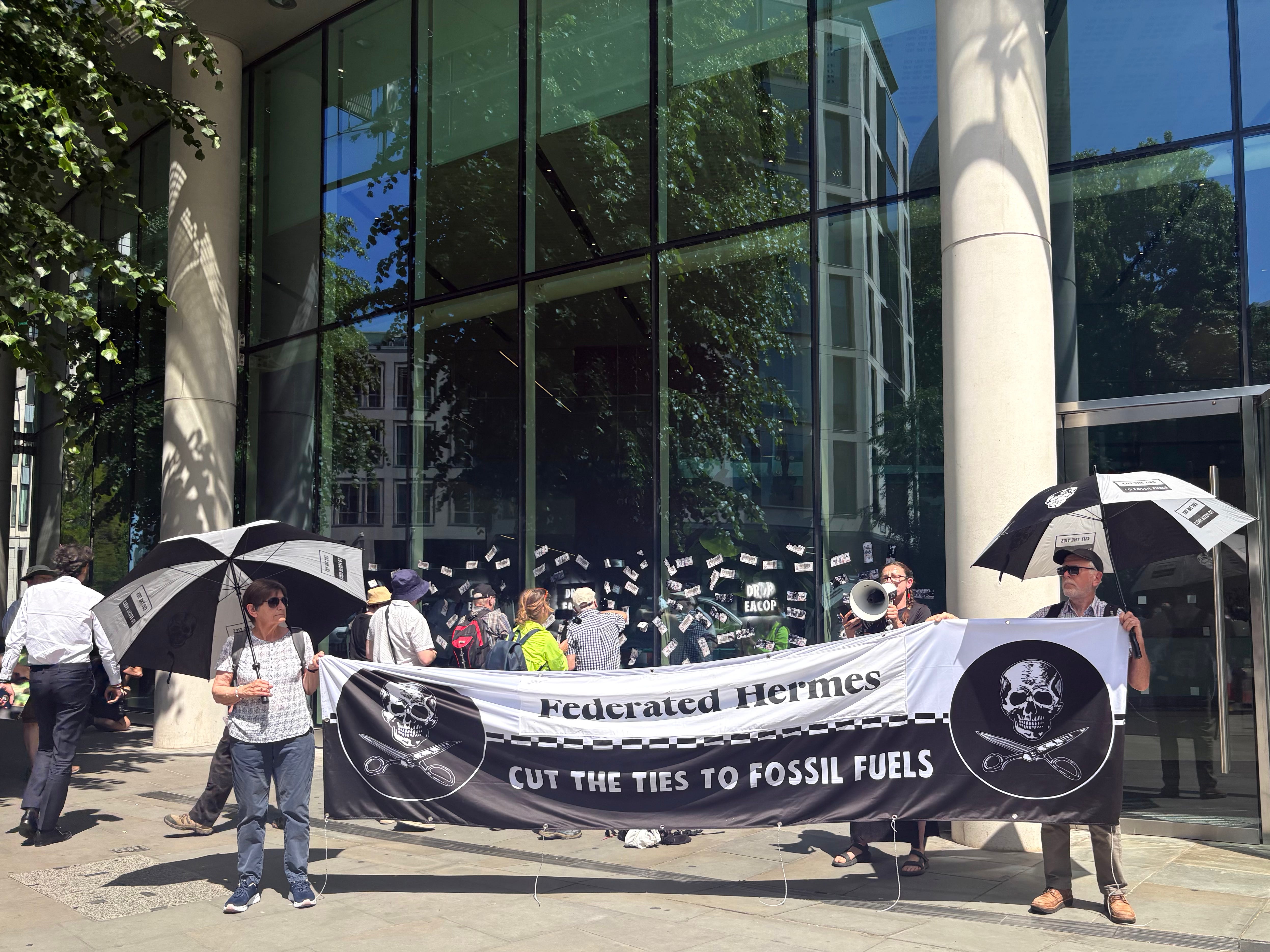
“Climate Change, Happening Now,” the woman cries out in a bright and breezy voice. She sounds like she is selling fun rides at an amusement park.
She is standing on a plaza in the City of London. It is earlier that same day, Tuesday, May 26, the day that turns out to be the hottest day in May on record.
The hottest May Day.
She is an activist with Cut the Ties to Fossil Fuel, a climate action group, and they have set their sights on Federated Hermes Limited, an investment management firm that describes itself as “a leader in active, responsible investment.” Yet Federated Hermes invests in TotalEnergies, the French energy giant which is the majority partner in one of the largest fossil fuel developments worldwide, happening now in East Africa, even though we have known for five whole years that continued development in new fossil fuels spells drastic changes for future generations on our planet.
I know less than I would like to about the East Africa Crude Oil Pipeline [EACOP] being built across 1,443 kilometers of pristine land and delicate eco systems stretching from Uganda to Tanzania but according to Human Rights Watch, the intimidation and abuse that has gone into acquiring the land, the displacement of people, the arrests of climate activists, and the threat to a fragile ecosystem, well, it certainly doesn’t look good.
According to TotalEnergies’ own report, this project will emit over 13.5 million tonnes of CO2 into our atmosphere over the lifetime of the project. But that is only the start. If you consider how the oil is used once it leaves the ports of Tanzania that number goes way high - 379 million tonnes according to the Climate Accountability Institute.
Our planet - our beautiful planet - cannot afford this.
Which is the point these activists want to make.
And so they come, mostly older people, and they stand with their banners and their microphone, calling on Federated Hermes to “drop EACOP,” and, as they chant to the office workers and tourists passing by, “cut the ties to fossil fuels.”
A spokesperson for Federated Hermes tells me that while they do invest in TotalEnergies, they do not invest in EACOP. The spokesperson points me to Equity Ownership Services at Federated Hermes (EOS), a stewardship provider that helps investors “act as responsible investors of the companies they invest in.” EOS engages with TotalEnergies through the Climate Action 100+ group, an investor-led initiative, which, in theory anyway, is meant to put pressure on the world’s largest greenhouse gas emitters, TotalEnergies being one of them, to do their business responsibly, with an eye to reducing their carbon footprint.
The Cut the Ties activists argue that TotalEnergies is therefore “aided and abetted” by Federated Hermes to continue with, in their words, “the disastrous EACOP project, putting profit before people and planet.”
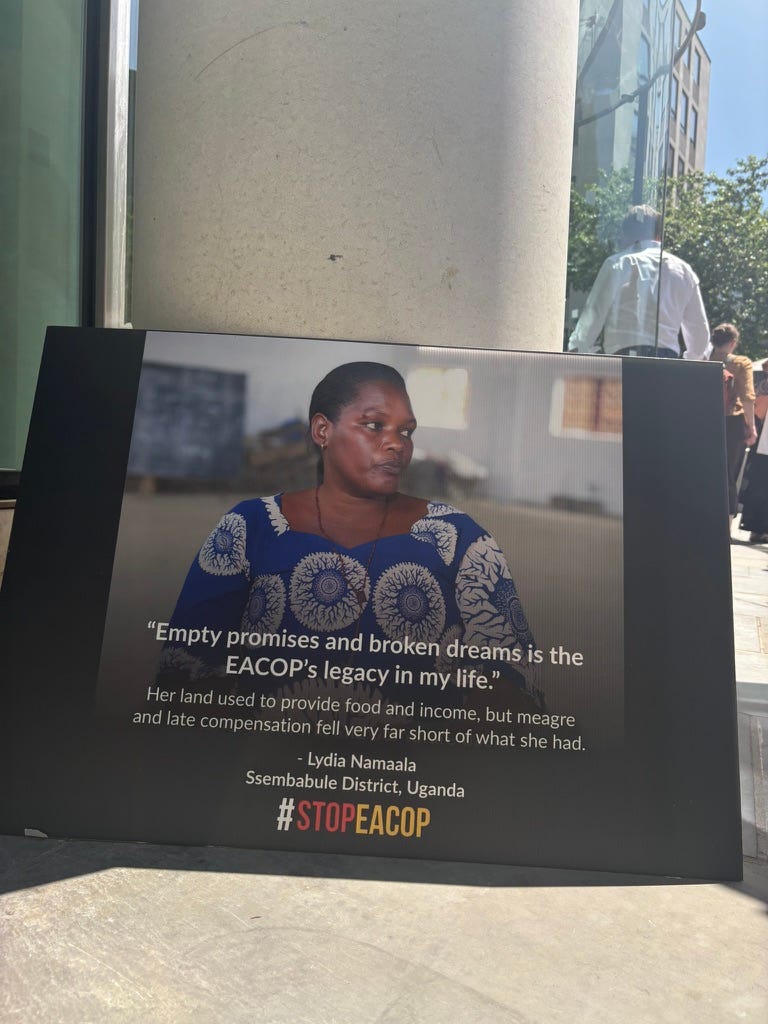
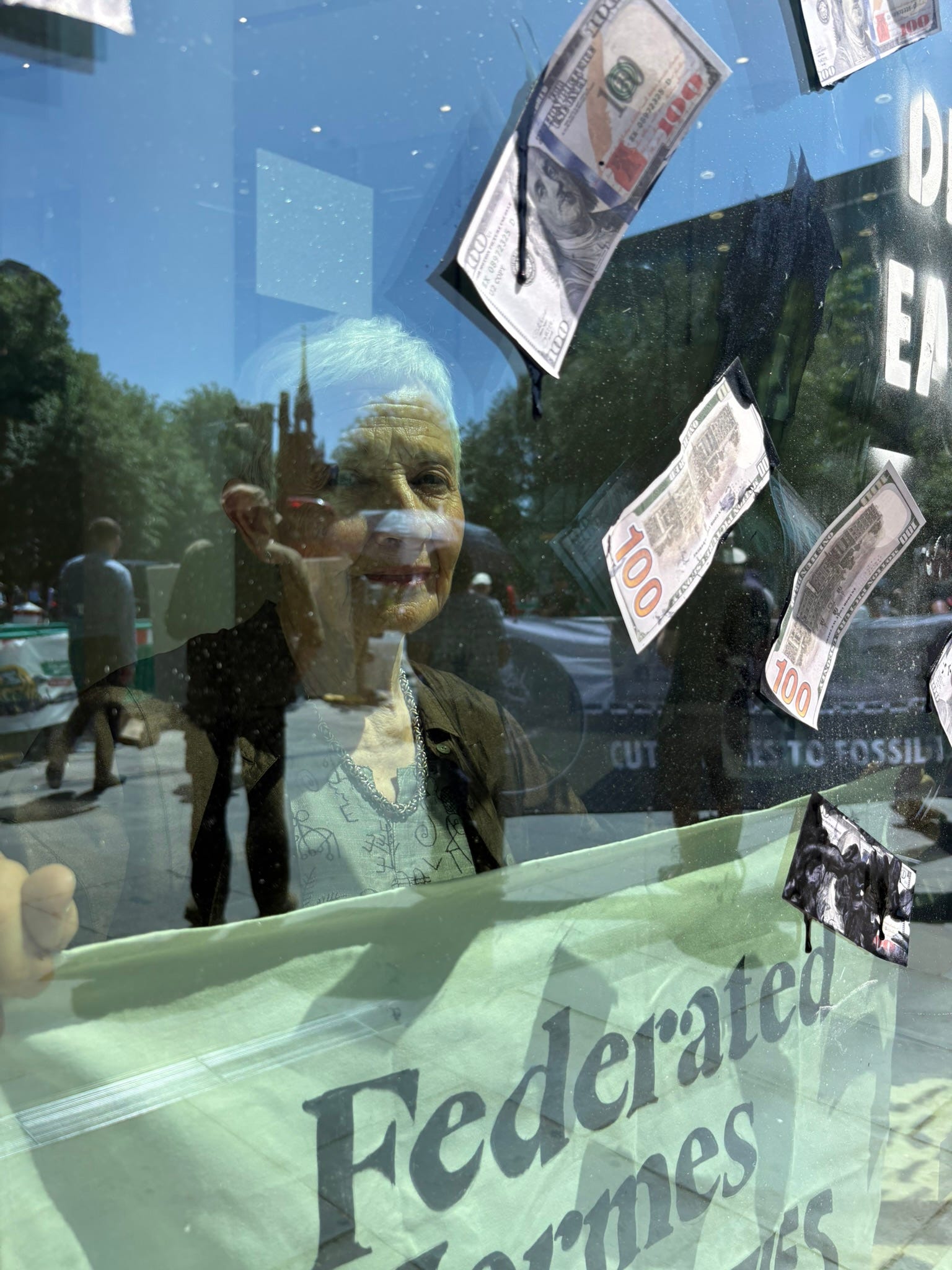
Activists who are okay with being arrested head into the building lobby. They are “the occupiers.” The rest stay outside in the midday heat, and stick “oily” dollar bills to the front windows and pass out leaflets.
A security man comes out, walkie talkie in hand, and the City of London Police arrive. It is all quite cordial. One of the police officers tells me they’ve known each other for almost a decade now, these police officers, these activists.
“We know each other’s lines in the sand,” he says.
A young business man waits at the pedestrian crossing, a leaflet in his hand. He works for Federated Hermes, he says, and, honestly, he doesn’t know about EACOP. He says he will read up on it.
I overhear a young man - cute as you like - tell the girl he is with that these protestors are just lonely old people with nothing better to do.
Carol, one of the occupiers, tears up when we talk.
How was it inside?, I ask her.
It was fine, she says, until a guy yelled at her that he doesn’t give a toss about fossil fuels. She wanted to shout back, “aren’t you lucky!”
We are living at a particularly tenuous time for our planet.
On this hottest week of weather in May on record, I read Elizabeth Kolbert’s piece in the New Yorker about Lee Zeldin, Trump’s head of the Environmental Protection Agency - the man who is gleefully rolling back the protections put in place by earlier administrations to cut fossil fuel emissions. In the UK, too many politicians and commentators are falling over themselves to argue that - in light of Trump’s war in Iran - the UK must drill every last drop of oil in the North Sea and drop its Net Zero targets.
Do they not see what is happening?
“Oh don’t start please,” the leader of Reform, Nigel Farage, says in an interview with the Financial Times. “The weather has always been crazy.”
I met an elderly lady a few weeks ago. She was a friend of a friend of mine. We got to talking about climate activism and she said that she didn’t really like climate activists. She asked me why I expected young people to suffer more now.
I was curious to know what she meant by this, but our mutual friend I could tell was shifting nervously on his feet and the conversation moved on.
Her question has stayed with me. What did she mean by “suffer now?”
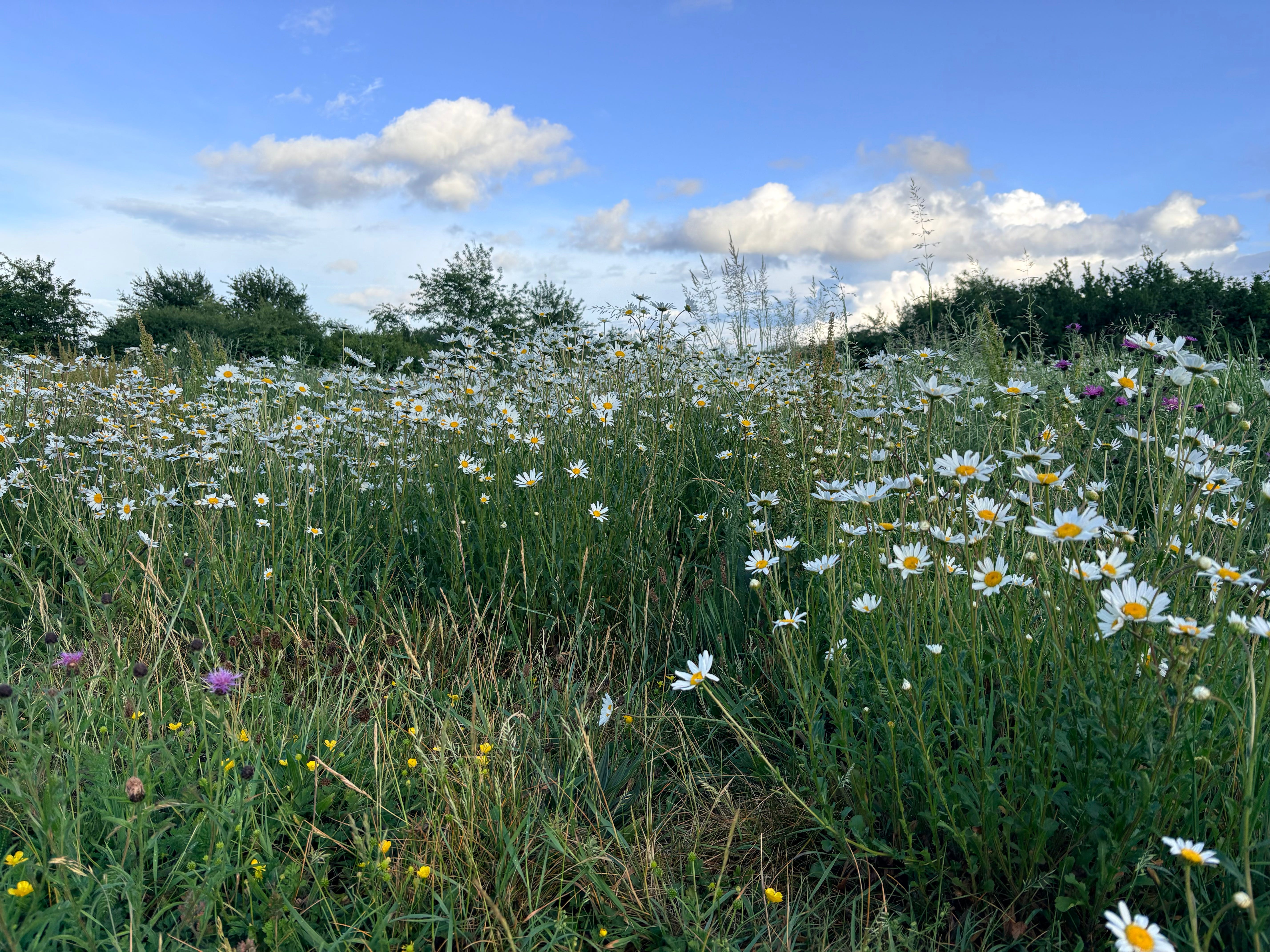
How is cleaner air suffering? Since when is a healthier diet a bad idea? What would be so terrible about restoring a biodiverse ecosystem - securing our food system against famine, drought and flood, or protecting our water supplies.
This sounds like less suffering to me.
On the BBC’s Farming Today, last week, in an interview with a farmer about the challenges farmers are facing in the UK because of our changing climate, “unseasonably hot” weather was mentioned but the climate crisis was not.
A farmer describes the difficulty she faced planting spring crops this year. April was unseasonably dry and so to try and get seeds down deep enough into the soil to catch hold of some of that moisture was not easy.
The reporter says, “I guess one of the solutions would be to build more reservoirs.”
Yes, that’s certainly one solution but, how about the need to urgently phase out fossil fuels?
In explaining why there was a water shortage in southeast England last week, another BBC reporter attributes it to “good” weather.
It’s not good weather. Not in May. It’s a harbinger of what is to come if we don’t accelerate all of the work that goes into cooling our planet.
Which means - at a minimum - ceasing all new fossil fuel development.
And that’s where EACOP comes in. Why, at this time when solar energy is on the rise across the African continent, when renewable energy is in the ascendance, when, whether Trump likes it or not, electric vehicles are set to account for close to 30% of all car sales in 2026, is TotalEnergies along with its partners, allowed to decimate a whole landscape, displace people from their homes, and risk a precious ecosystem, all for a dying energy source that is wrecking havoc on our planet?
“Climate Change, Happening Now,” the activist cries out in her bright and breezy voice.
Any responsible investor should be asking these questions.
https://en.wikipedia.org/wiki/East_African_Crude_Oil_Pipeline
https://www.nytimes.com/2023/03/14/world/africa/oil-pipeline-uganda-tanzania.html
Hottest May Day Ever: https://www.bbc.co.uk/newsround/articles/ce8pjm0v85lo
Climate Whiplash: https://www.ft.com/content/9709c84a-1d62-4ac1-92dd-e4a0f9553a34?syn-25a6b1a6=1
https://www.instagram.com/cuttheties.25/
https://www.hermes-investment.com/uk/en/individual/about-us/
https://stopeacop.net/blog/kick-polluters-out-from-hoima-to-edinburgh-communities-are-taking-action/
https://newint.org/uganda-cracks-down-climate-activists
https://www.hrw.org/news/2023/07/10/uganda-oil-pipeline-project-impoverishes-thousands
https://www.hrw.org/news/2025/11/06/uganda-continues-targeting-fossil-fuel-activists
https://www.climateaction100.org/company-assessments/totalenergies-se/
https://www.theguardian.com/environment/2022/oct/27/east-african-crude-oil-pipeline-carbon
https://mialesolar.com/solar-farms-the-driving-force-behind-africas-clean-energy-transition/

https://www.newyorker.com/magazine/2026/05/04/can-the-epa-survive-lee-zeldin
Interview with the New Yorker’s Elizabeth Kolbert: https://www.npr.org/2026/04/29/nx-s1-5803848/how-trumps-epa-head-has-transformed-the-agency-and-sided-with-polluters
Nigel Farage on the weather: https://www.ft.com/content/3aca829d-d523-484b-a5b8-744642ec5f70?syn-25a6b1a6=1
Farming Today, May 27, 2026: https://www.bbc.co.uk/sounds/play/m002wv6f
https://www.bbc.co.uk/news/articles/cn4prrm7dl9o
My brother’s coffee: www.cosmopolis.com